
‘The Art of the Heal’: How TrumpRx, most-favored nation pricing, Big Pharma intersect
AstraZeneca has now joined Pfizer in agreeing to sell its drugs to state Medicaid programs at “most-favored-nation” pricing and deeply discounted rates on TrumpRx.gov
But what does that mean?
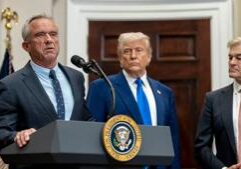
Last week, President Donald Trump and Health and Human Services officials announced the forthcoming creation of TrumpRx, a direct-to-consumer website where Americans will be able to buy some of their medications for less. They also unveiled the first-of-its-kind deal they’d reached with pharmaceutical giant Pfizer on drug pricing for Medicaid – a deal they’ve now secured with AstraZeneca, as well.
The drug manufacturers have also mentioned selling all of their new drugs at most-favored-nation pricing, though the implications of this are still unclear.
How it started
In May, Trump signed the executive order “Delivering Most-Favored-Nation Prescription Drug Pricing to American Patients,” aimed at addressing inequities in what the U.S. pays for medical drugs compared to other wealthy countries.
Sometimes Americans pay 10 times more than citizens of an economic peer country for the same medication. Most of the time, it’s more like two or three times as much. Trump has framed it as other countries capitalizing on innovation underwritten by Americans, as the U.S. funds a large portion of pharmaceutical research and development.
“Americans should not be forced to subsidize low-cost prescription drugs and biologics in other developed countries, and face overcharges for the same products in the United States,” the order reads.
What is “most-favored-nation pricing”?
Most-favored-nation pricing means the U.S. would pay no more for a drug than the lowest price paid by peer nations.
Where Big Pharma comes in
Trump threatened pharmaceutical companies that didn’t make the shift with “aggressive action” from his administration. Pfizer is the first to have reached an agreement with the administration and complied with the MFN directive, and now, AstraZeneca.
Who benefits?
Pfizer and AstraZeneca have agreed to sell their drugs to state Medicaid programs at most-favored-nation pricing. It’s not yet clear how the new pricing compares to what Medicaid has been paying, but it could result in real savings for states.
AstraZeneca CEO Pascal Soriot said Friday he believes the American economy will also benefit from the “equalization” of drug costs across countries.
“It’s a big win for patients and the healthcare system as a whole, but it’s also a big win for the economy and for taxpayers, because it supports rebalancing the cost of innovation across wealthy nations. For too long, America has shouldered a disproportionate portion of the world’s R&D,” Soriot said. “That imbalance is not sustainable.”
These companies have also committed to selling all new drugs at most-favored-nation pricing, though it’s unclear if this would again only apply to Medicaid programs and when it is supposed to go into effect.
“We also have MFN for all new prescription drugs, Mr. President. By the time this term is done, 95% of all drugs sold in America, branded drugs and generic will be available at most favored nation drug pricing,” Soriot said.
TrumpRx: Discounted prescription drugs sans middleman…
Some pharmaceutical manufacturers have recently begun offering some of their products on their websites for much less. TrumpRx is jumping on this direct-to-consumer bandwagon and will function as a kind of online marketplace for people looking to buy deeply discounted drugs.
So what’s the catch?
But people using TrumpRx can’t use insurance. There is no middleman with direct-to-consumer products – no CVS Pharmacy and no insurer, either. So TrumpRx is really for people without insurance or who have lost it temporarily or for instances where it makes more sense to pay a discounted price than to use insurance, like when insurance doesn’t cover a particular drug.
Pfizer has shared some of the drugs it has agreed to offer through the TrumpRx platform, some of which will be available at an 80% to 85% discount. Others will be discounted less, like Xeljanz. Xeljanz is an oral medication for ulcerative colitis and some types of arthritis, and patients can purchase it at 60% of its sticker price – which unfortunately is still over $3,600 per month.
In most cases, a medication will likely be cheaper (or much, much cheaper) with insurance. In Xeljanz’s case, it’s often covered through insurance and in some cases, patients pay only $25 a month, as the New York Times reported.
However, Trump said Friday drug prices would be going down “100%, 400%, 600% – 1,000% in some cases” and that these deals would “have a huge impact” on Medicare and Medicaid, but also on Social Security.
He gave an example of an expected 654% price reduction.
“One particular drug that’s hot, very hot – 654% on inhalers, COPD and asthma, as well as certain diabetics medications – they’re going to be averaging about 654% reduction in price,” he said.
Other downsides
Most of the cost of a drug comes from research and development, and the president has said the U.S. pays a “disproportionate amount” of those costs. Director of Medicare Chris Klomp has said the U.S. “[drives] more than 50% of global R and D, 50% of revenues, nearly 70% of profits” for pharmaceutical companies.
Some have said America’s new pricing arrangement will harm pharmaceutical R & D.
“The Trump administration is right to focus on foreign countries free riding off American innovation, but the administration needs to do more to address unfair practices abroad,” said the Pharmaceutical Research and Manufacturers of America, or PHRMA, in a statement shared with The Center Square.
“Other countries routinely undervalue medicines and limit their citizens’ access to the newest treatments. Most Favored Nation policies that would import these same prices into the U.S. would result in less access to treatments and cures and reduced investment in manufacturing and R&D.”
Does all of this actually make a difference?
The vast majority of Americans (92%, in fact, according to Census Bureau data) have health insurance and likely won’t need to use TrumpRx in most situations, from what is currently known about the platform.
And despite Pfizer’s agreement to sell its drugs to Medicaid programs at most-favored-nation pricing, Medicaid enrollees likely won’t notice much of a difference either, since they already get their prescriptions at little to no cost.
And it’s unclear at this time what the intended scope is for Pfizer and AstraZeneca’s new drugs to be offered at MFN pricing.
But if seen as a part of a broader movement in government for greater transparency in health care, the news isn’t insignificant.
A larger push for transparency
There’s been a concerted government effort in recent years to push for more transparency in an incredibly complex industry with inscrutable pricing. In his first term, Trump issued some executive orders that required hospitals and insurance companies to publicly disclose some pricing information. The Biden administration doubled down on this initiative by ramping up enforcement measures and noncompliance penalties and creating new requirements for prescription drug reporting and price comparison tools.
Chris O’Dell, a spokesperson for health care price transparency platform Turquoise Health, said the deal for MFN pricing and the development of TrumpRx will continue to advance price transparency in health care.
“I think what they’re doing is making a big splash and casting eyes and a conceptual need for transparency onto one of the most opaque and unaffordable corners of health care. And in that sense, it’s a good thing, even though it’s going to take months, if not years, for it to unfold,” O’Dell told The Center Square.
“The worst case scenario is it’s a big, splashy headline that does nothing… and the best case scenario is that there’s real change that means that you actually pay less for the drugs that you need,” O’Dell told The Center Square. “That has not happened.”
TrumpRx may not help most Americans in the near-term, but O’Dell doesn’t think it was a wasted effort.
“The administration is hell bent on letting people know what they’re going to pay for health care before they go in and get it. And they’re turning that focus on to drugs. And that’s a good thing,” O’Dell said.
“They’re… casting eyes and a conceptual need for transparency onto one of the most opaque and unaffordable corners of health care… It’s a good thing, even though it’s going to take months, if not years, for it to unfold.”
And unlike many government reforms that have unintended consequences and can make the problem they’re trying to solve even worse, O’Dell doesn’t foresee that with these changes.
“There’s nothing in this that would ever make someone pay more or be worse off than before.”
Other necessary reforms
But O’Dell and others say American health care still desperately needs reforms in another area of the pharmaceutical industry: pharmacy benefit managers.
The Commonwealth Fund describes PBMs as “companies that work with health insurers, large employers, and other payers to manage their prescription drug benefits.” AI search assist says they “help to reduce prescription drug costs through price negotiations and utilization management.” But many in the health care industry say they actually inflate drug prices and simply “add another layer of secrecy” to the drug pricing process.
“We need to make the PBMs also put their rates out… Hospitals did it, payers did it, but the PBMs got away with not doing it. Why is that? And I would love to see the administration tackle that and say now you have to publish historical net price,” O’Dell said.
Miriam Paramore, founder of RxUtility, a website that helps insured Americans find and access prescription savings, also mentioned PBMs in an interview with The Center Square. Paramore thinks the administration’s announcement does address a driver of health care costs with MFN pricing. But a good next step would be PBM reform.
“What is as significant of a driver with the overall price of medications is also what you see in PBM reform. MFN pricing and PBM reform are big drivers of the cost of drugs,” Paramore said.
And so does PHRMA. It called PBMs and other federal programs the “real drivers of higher prices in the U.S.”
“PBMs get big discounts on medicines while charging patients full price. Hospitals abuse the 340B program to mark up drug prices by 700% or more. Addressing these abusive practices would dramatically lower drug prices for U.S. patients,” PHRMA said in a statement.
What’s next
TrumpRx is expected to launch in January 2026. The administration has said more deals with other drug manufacturers are underway.
Both Pfizer and AstraZeneca have pledged to invest tens of billions ($120 billion all told) in their manufacturing presence in the U.S. AstraZeneca just broke ground on a new, $4.5 billion plant that will make active pharmaceutical ingredients, most of which the U.S. currently gets from other countries like China and India.
These investments will shield those companies from tariffs for the next three years, as Trump has said companies that pledge significant American investment will be.






Chance Rain Showers then Mostly Cloudy
Latest News Stories

Suspect Captured in Execution-Style Murder of Momence Bar Owner

Mokena Library Board Approves Annual Audit; Auditors Report “Internal Controls Working Well”

First lady meets with former Oct. 7 hostages

Supreme Court declines challenge to California’s congressional map

Candidate: $243 million in unlawful spending is example of ‘Preckwinkle’s mismanagement’
GOP lawmakers urge Thune to tweak filibuster rules to pass voter ID bill

Illinois housing crunch sees prices rising, units dwindling
700 federal agents to leave Minnesota, Homan says

New York, New Jersey sue feds over Hudson Tunnel funding cuts

Parents sound alarm over Illinois high school voter registration bill

Illinois Quick Hits: Violent Crime down, arrest rates up in Chicago

Judicial manual pushes climate agenda, critics say