
WATCH: Father of Housing First points to success; We Heart Seattle highlights failures
On an overcast mid-October day, just inside the Third Avenue offices of We Heart Seattle, Executive Director Andrea Suarez and two of her staff members sat next to a table covered with gallon-sized Ziploc bags filled with used drug foil collected in recent weeks from parks and streets in Seattle.
On an adjacent table, a “harm reduction” kit provided to drug addicts by Public Health – Seattle & King County displayed clean drug needles, wound care wipes, Narcan to reverse drug overdoses, foil, note cards suggesting addicts use drugs together to help prevent overdoses, and many other items that Suarez says are worsening the city’s drug crisis.
“I’ve probably picked up a hundred thousand needles and now a hundred thousand or more pieces of foil,” she told The Center Square. “And my motto is always like the truth was beneath the trash.”
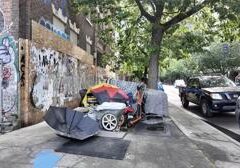
Suarez’s journey began early in the pandemic, with a small group of volunteers cleaning up drug sites and abandoned homeless camps where tons of garbage and drug paraphernalia piled up across Seattle parks.
“And as I got into the belly of the beast, picking up trash, I started forming opinions about the needle exchange program and how we were putting our loved ones inside places only to see them back out on the streets because they couldn’t adhere to the rules, or they were getting in fights, or they were getting arrested, or they were burning the place down or they were simply grimly dying,” she explained.
That, she said, was the point she started really questioning the Housing First model, where those on the streets are provided housing, but in most cases are not required to participate in drug treatment or behavioral health programs.
“Some people had housing; in fact, many people had housing, but still were loitering and hanging out in the drug scenes,” Suarez continued. “I tried to refrain from saying encampments because nobody’s in the park in a tent roasting marshmallows and making s’mores. These are drug scenes. The tents are used for storing stolen items, trafficking, drug distribution and drug use.”
Suarez only has a few paid staff members. She also has many volunteers who have spent thousands of hours cleaning up drug sites, building relationships with addicts on the street, and getting many of those addicts into treatment, ultimately saving their lives.
“Here I am, five years later, as a subject matter expert. Why?” she asked. “My data is empirical. It’s what I saw with my own eyes, and over 40,000 volunteer hours, 500 cleanups, including cleanups indoors at these various low-barrier Housing First projects. We call them dig-outs, where the garbage is so stacked from floor to ceiling. Rats, roaches, bugs. I’ve seen cockroaches an inch long by the hundreds, if not thousands, in some of these units, and people simply move out, and that’s where I meet them.”
While Suarez passionately opposes Housing First as a model to address the drug crisis, the man considered to be the father of Housing First still supports the idea and says it’s saving lives.
“Housing First came to be because there were people on the street that had mental illness and were unable to leave the streets on their own,” Dr. Sam Tsemberis, who now serves as the CEO of the Pathways Housing First Institute, and is also on the faculty of the UCLA Department of Psychiatry and Biobehavioral Sciences, told The Center Square. “And the system that was in place before Housing First was an effort to get people into treatment, to get them stable, and then reward them with housing. And that’s all there was.”
Tsemberis said the idea was to house people first and then engage them in services and, eventually, treatment.
Critics point out that most of the homeless living on the streets 20 years ago were abusing alcohol and cocaine, and not more lethal street drugs like fentanyl, which is killing hundreds of Americans every day.
“The idea of the terrible drug is part of the folklore of the approach to insisting on sobriety. When housing first started, it was the crack epidemic. And they were like that’s the most lethal drug we’ve ever seen,” Tsemberis said. “Now, you know, I mean, these drugs are terrible drugs, but the solution for homelessness is housing, and people do better. The evidence for the program has been consistent. If you give someone a home with the right supports, their homelessness will end. So, it not only worked 20 years ago, but it also continues to work now.”
Suarez vehemently disagrees.
“We’re doing this 20 years in, right? And it’s a whole airplane, a whole 747 jet every day that falls out of the sky nationwide. It crashes to the ground and kills 300 plus people a day in our country and in North America, and we are not sounding the alarm that we have a drug crisis, and we need to intervene and mandate people to go to treatment to save their lives,” she said.
Suarez and her staff walked up and down a few blocks of Second and Third avenues in Seattle. Addicts recognized the We Heart Seattle team and engaged in conversation. Some said they were ready to get off the street, admitting they needed help. Others shared stories of being evicted from their homes.
One woman whom Suarez knew well asked the team to help her clean her apartment in Fremont, saying she wanted to enter treatment. Suarez hugged her and handed the woman her card, saying that if she was truly ready, the organization would be there to help.
Walking away, Suarez said she has had that same conversation with the woman repeatedly, but is hopeful that one day the woman will actually be ready.
One last stop was made to check on a woman living in one of the city’s low-barrier properties. Suarez notified the woman, Jennifer, that the new mattress We Heart Seattle had ordered for her would be coming later that day. No city funding or grants pay for that. It’s all donations.
Tsemberis is concerned about President Donald Trump’s July executive order ending Housing First support, encouraging law enforcement and expanding involuntary commitment.
“This is an administration that’s not following the science on anything,” he said. “And what I’m very concerned about is that they want to move everything back to where people need to be in treatment and be sober before they get housing. It’s going to increase homelessness. And it doesn’t make sense to me.”
Suarez has a much different take on Trump’s reset to address the drug and homelessness crisis.
“Heck yeah, his executive order and what he’s doing at the border and taking down some of these drug cartel boats in our open waters that are coming here to take the lives of our loved ones – I am behind that a hundred percent,” she said.
Suarez said her passion for We Heart Seattle has come at a high cost. Her marriage fell apart, she lost a lot of friends, and some health issues have been ignored, but she’s not giving up, she said, because she knows she’s on the right side of the issue and human lives are at stake.
“How did these low-barrier Housing First projects really become expensive coffins? We know that the stats show more than half of the overdoses in our state are from a fixed address. So, is this not end-of-life care? Is this not hospice care? And if it is, let’s just call it that and stop pretending,” she said.






Slight Chance Showers And Thunderstorms
Latest News Stories

Will County Public Works Committee Shelves License Plate Reader Agreement Amid Bipartisan Privacy Concerns

Will County Planning and Zoning Commission Overrides Staff to Approve New Lenox Accessory Building Variance
Will County Sheriff’s Office Welcomes Remi, First Electronic Scent Detection Dog

Will County Transportation Department Announces Open House for Manhattan-Monee Road Expansion

Will County Community Mental Health Board Faces $5 Million Shortfall in 2026 Grant Requests
Meeting Summary and Briefs: Public Health & Safety Committee for March 5, 2026

Will County Officials Warn of Zoom Court Scam Targeting Defendants for Fraudulent Dismissal Fees

Will Land Use Committee Evaluates Multi-Million Dollar Buyout for Flooded Harris Drive Homes

Behavioral Health Division Drops Wait Times, Reports Zero Opioid Deaths in February

Harris Drive Residents Plead for County Intervention Amid Failing Septic Systems and Flooding

Will County Sheriff’s Office Investigates Fatal Hit-and-Run in Homer Glen

Federal Funding Freezes Threaten Will County Public Health Programs Amid Ongoing Lawsuits