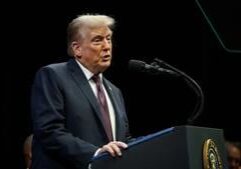
Judge: SCOTUS ruling doesn’t necessarily end block on Trump DEI orders
A Chicago federal judge has declined to pare back his order blocking the Trump administration from cutting off federal funds to groups that promote “diversity, equity and inclusion,” despite a U.S. Supreme Court decision that would appear to potentially limit the judge’s ability to impose such an injunction nationwide.
On Oct. 30, U.S. District Judge Matthew F. Kennelly again ruled in favor of the group known as Chicago Women in Trades (CWIT) in their legal action against the White House over President Donald Trump’s executive orders prohibiting federal grants and other federal money from going to organizations which promote so-called DEI initiatives and goals.
In his latest ruling, Kennelly said he did not believe a U.S. Supreme Court ruling otherwise limiting the ability of federal district judges, like Kennelly, from issuing nationwide injunctions doesn’t apply in this case, because only a nationwide injunction can give CWIT the “complete relief” the group needs to be protected against the scope of the president’s orders.
Specifically, in this case, Kennelly said his injunction should not be limited only to CWIT, as the plaintiff, because otherwise the order could still be applied to other organizations and entities with whom CWIT may wish to “collaborate” on its DEI goals.
“As the Court previously observed, that provision offers no definition of DEI and thus chills recipients from engaging in a wide range of activities,” Kennelly wrote. ” This chilling effect is likely to encompass much, if not all, of CWIT’s programming.
“… For other recipients, collaborating with CWIT would come with the risk of losing federal funding or making a certification that will be deemed false and thus subject them to liability under the False Claims Act. By enjoining enforcement against all recipients, the injunction protects CWIT from losing its collaborative prospects…,” Kennelly wrote in his order.
The ruling comes as the latest step in a court fight that began earlier this year, almost immediately after Trump took office and issued the anti-DEI orders as some of the first acts of his second term in office.
In issuing the orders, Trump said he believed federal money should not flow to organizations which promote policies intentionally and explicitly designed to illegally discriminate on behalf of people who are not white or male, or who are not LGBTQ.
Under the orders, nonprofit organizations receiving federal money must certify that they are not engaged in promoting DEI initiatives or policies, in order to continue receiving federal money.
In its lawsuit, CWIT asserted Trump’s orders were illegal and violated CWIT’s First Amendment rights to explicitly promote the hiring of women in the building trades and related industries. The lawsuit claimed that cutting off federal funds would endanger both the mission and continued existence of CWIT and similar groups.
According to its website, CWIT seeks to “break the concrete floor,” and address what they call a “disparity” between men and women in the buildings trades. They assert that less than 5% of the trades workforce in Illinois is female, “despite federal legislation prohibiting gender discrimination in hiring.”
CWIT has been awarded federal grants, authorized in congressional legislation, ostensibly to support its mission. The grant comes in the form of a cut of $5 million authorized under the so-called Women in Apprenticeship and Nontraditional Occupations (WANTO) law, which has been on the federal books since the early 1990s.
The program’s dollars are administered through the Labor Department’s Women’s Bureau.
In his first ruling in the case in April, Kennelly agreed that forcing nonprofits to certify they are not promoting DEI amounts to likely violations of the First Amendment, as he said it would force federal grant recipients to reject DEI if they wish to continue receiving federal money.
The judge said he believed the effect of the anti-DEI executive orders is to attempt to improperly silence groups like CWIT “outside the program” and its funding.
Kennelly rejected the Trump administration’s contention the executive orders are only intended to force CWIT and other federal grant recipients to merely follow federal non-discrimination laws, which forbid race- and gender-based preferences.
In that ruling, Kennelly also asserted the injunction needed to go nationwide, rather than just protect CWIT, so as to similarly shield other groups, who the judge said may be more reluctant to sue the Trump administration to allegedly protect their rights in court.
Without the nationwide injunction, Kennelly said those groups could choose to “self-censor” and voluntarily chill their speech rights rather than risk a confrontation that could result in losing funding.
The Justice Department appealed Kennelly’s ruling to the U.S. Seventh Circuit Court of Appeals, where the case remains pending.
However, after Kennelly’s ruling, the U.S. Supreme Court weighed in on the question of whether such nationwide, or “universal” injunctions are proper and constitutional.
In the June 2025 decision known as CASA v Trump, the Supreme Court decided a federal district court judge likely lacked the constitutional authority to issue a nationwide injunction broadly blocking a different executive order from Trump, purporting to end birthright citizenship.
Specifically, the high court granted Trump’s request for a partial stay of the nationwide injunction issued against the citizenship-related executive order by a Maryland federal district judge.
In the 6-3 ruling, the Supreme Court said it believed district courts generally have the ability to only grant injunctions on behalf of the parties actually involved in the litigation, and generally cannot issue sweeping nationwide injunctions on behalf of non-parties who did not sign on to the lawsuits.
Following the Supreme Court ruling, lawyers for the White House asked Kennelly essentially to reevaluate his decision, to see if he agreed his nationwide injunction was improper in light of the holdings in CASA.
Kennelly, however, rejected the Justice Department’s arguments, saying he believed the nationwide injunction was still proper.
To justify his decision, Kennelly pointed to language in the CASA ruling, in which the Supreme Court stated judges were not prohibited from using nationwide injunctions if they believe the injunction is needed “to ‘administer complete relief between the parties.'”
Kennelly said limiting the injunction only to CWIT would still allow the government to use the anti-DEI executive orders to pinch CWIT by “chilling” its possible business relationships with others who may fear running afoul of the White House, which Kennelly said would violate CWIT’s First Amendment rights.
“… The injury to CWIT is not merely an abstract social cost; the Certification Provision, if enforceable against others, acts as a barrier to collaborating with CWIT,” Kennelly wrote, since CWIT’s mission is entirely to advance DEI – in this case, specifically to advance equity and inclusion for women in the building trades.
“The benefit to CWIT from removing that barrier would suffice for Article III standing and, more relevant to this motion, warrants enjoining enforcement against others.”
CWIT is represented in the action by attorneys with the Economic Justice Project at the Lawyers’ Committee for Civil Rights Under Law, of Chicago.
Community Events
Latest News Stories

GE Appliances announces $150 million partnerships
Frankfort, Will County Partner on Wildlife Rabies Control
Executive Committee Approves Appointments for Washington Township, Emergency Telephone Boards
Trump signs bill to release Epstein files

WATCH: Dysolve AI offers approach to dyslexia in schools

Inventors back effort to tackle intellectual property thefts

WATCH: Dems leave hearing before minority group’s testimony on Biden border policies

Illinois quick hits: ICC approves smaller rate increases
WATCH: Ex-Illinois governor pushes for ‘millionaire’s surcharge’ amendment

Lawmakers weigh replacing Obamacare tax credits with health savings accounts

Feds: Guilty plea hearings scheduled for Antifa members indicted on terror charges
Lawyers call legal immigration crackdown harmful