Artemis II heads to the moon with first crewed mission since 1972
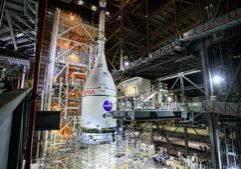
America is going back to the moon, after Artemis II lifted off from Cape Canaveral, Fla., Wednesday evening, more than five decades after Americans last set foot on the moon.
The lunar-bound spaceship lifted off shortly after 6:30 p.m. from the Kennedy Space Center, the first mission to the moon since 1972, when Apollo 17 spent over three days on the surface of the moon.
Artemis II is being manned by three American astronauts and one Canadian, commanded by Ret. U.S. Navy Capt. Reid Wiseman, piloted by U.S. Navy Capt. Victor Glover, along with mission specialists Christina Koch and Jeremy Hansen.
Artemis II marks some historical firsts for NASA. Koch will be the first woman astronaut to travel to the moon, while Hansen is set to be the first Canadian astronaut to make the trek.
The Artemis II mission will orbit the moon and is expected to last 10 days. The Orion spacecraft is expected to travel nearly 250,000 miles from Earth, the furthest a human has ever traveled from Earth.
The mission, which followed Artemis I, launched in 2022 as an unmanned lunar spaceflight — leading the way for other Artemis missions. Artemis I, II and III —eventually paving the way for Artemis IV in 2028, when humans are expected to set foot on the lunar surface.
The Artemis II mission is expected to pave the way for NASA to build a moon base, similar to the International Space Station. Ultimately, NASA plans to send humans to Mars.
Artemis II’s mission mirrors the Apollo 8 mission, launched in December 1968, paving the way for the Apollo 11 mission, which saw astronauts Neil Armstrong and Buzz Aldrin make history as the first humans to set foot on the moon.
At the time of the Apollo 8 mission, which orbited the moon on Christmas Eve 1968, it was considered the most dangerous mission NASA had undertaken to that date, with only a 50/50 chance of return. The mission proved an enormous success for the space program.
Over the past 45 years, the U.S. has focused its human space missions on orbiting Earth. Despite not launching a mission beyond Earth’s orbit in nearly 60 years, costs for the latest mission program have decreased.
The Apollo program cost American taxpayers $290 billion (inflation-adjusted) by the time of the first moon landing, Apollo 11, in 1969. NASA predicts the Artemis program will cost taxpayers $105 billion by the first landing, which is expected to launch by 2028.
The space capsule is expected to splash down off the coast of California.






Sunny
Latest News Stories

P&Z Commission: New Women’s Recovery Center Proposed for Patterson Road Receives Support

Main Park Playground Nominated for National “Playground of the Year”

Ogalla Blasts New State Solar Legislation

Committee Postpones Vote on Brandon Road Fill Operation After Tree Clearing Allegations

Meeting Summary and Briefs: Will County Planning and Zoning Commission for December 2, 2025

Metra Announces No Fare Hikes; Highlights Bridge Projects in Joliet and Mokena

Public Works Committee: Will County Consolidates Paratransit Services Amid Funding Debates

Park Board Pivots to Van Purchase Following Bus Price Increases

P&Z Commission: Peotone Area Variances Forwarded for Garage and Pole Barn
Peotone License Plate Camera Renewal Sparks Privacy Debate in Public Works Committee

Meeting Summary and Briefs: Mokena Community Public Library District Board for October 28, 2025
Par District Explores Expanded Fireworks Show for USA’s 250th Anniversary