Will County Explores Multi-Million Dollar Downtown Joliet Consolidation and City Partnership
Will County Capital Improvements & IT Committee Meeting | April 7, 2026
Article Summary: The Will County Capital Improvements and IT Committee reviewed four sweeping architectural options to consolidate county government facilities in downtown Joliet, including a potential partnership to build a joint complex with the City of Joliet. Financial advisors also presented bonding scenarios that could fund up to $142.8 million in construction without raising the county’s current annual debt service.
Facilities Master Plan Key Points:
-
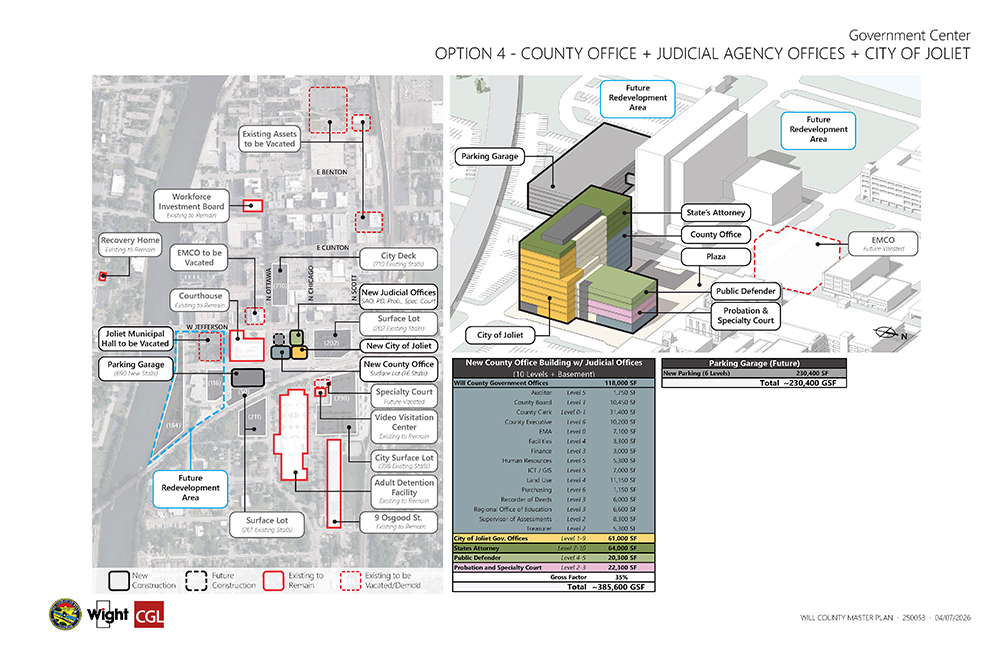
Space projections indicate the County Office Building needs to grow from its current 62,260 square feet to 118,000 square feet by 2050.
-
Wight & Company presented four consolidation options for downtown Joliet, ranging from a standalone county facility on the old courthouse site to a “mega consolidation” housing both county and city government.
-
City of Joliet City Manager Beth Beatty addressed the committee, expressing strong support for a joint “one-stop shop” facility.
-
Speer Financial presented three borrowing scenarios, showing the county could issue between $103.9 million and $142.8 million in new bonds while maintaining its targeted $25 million annual debt service.
-
The county currently leases the “PACE building” at 9 Osgood Street to the City of Joliet for $1 a year on a 99-year lease.
The Will County Board Capital Improvements & IT Committee on Tuesday, April 7, 2026, took its first major step toward a massive overhaul of its downtown Joliet footprint, reviewing four architectural consolidation scenarios that could fundamentally reshape local government operations.
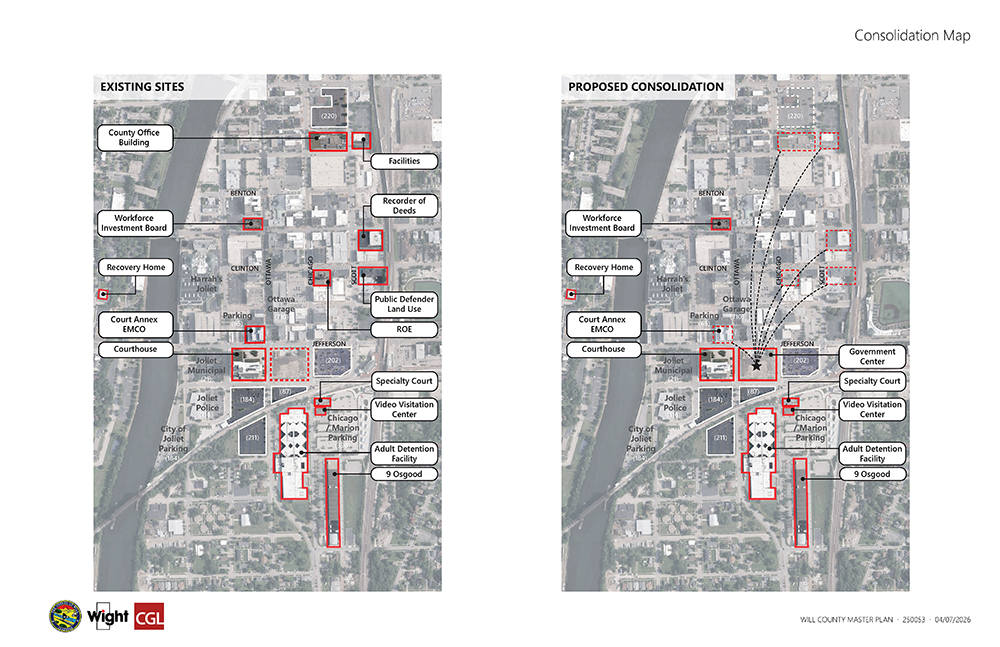
Jason Dwire of Wight & Company presented the updated Facilities Master Plan, highlighting the urgent need to replace or expand the current County Office Building (COB) and the MCO Building, which currently houses the State’s Attorney and Probation departments. According to the data, the county’s core government functions currently occupy 62,260 square feet but will require 118,000 square feet by 2050.
“This building here, it doesn’t really accommodate all of the county government functions,” Dwire said, referencing a map showing county offices scattered across downtown. “It certainly doesn’t meet any of the projected needs going forward. The same is true in the MCO building… Both buildings are going to need significant continued investment to maintain them, and they’re not in the best layout or best shape to begin with.”
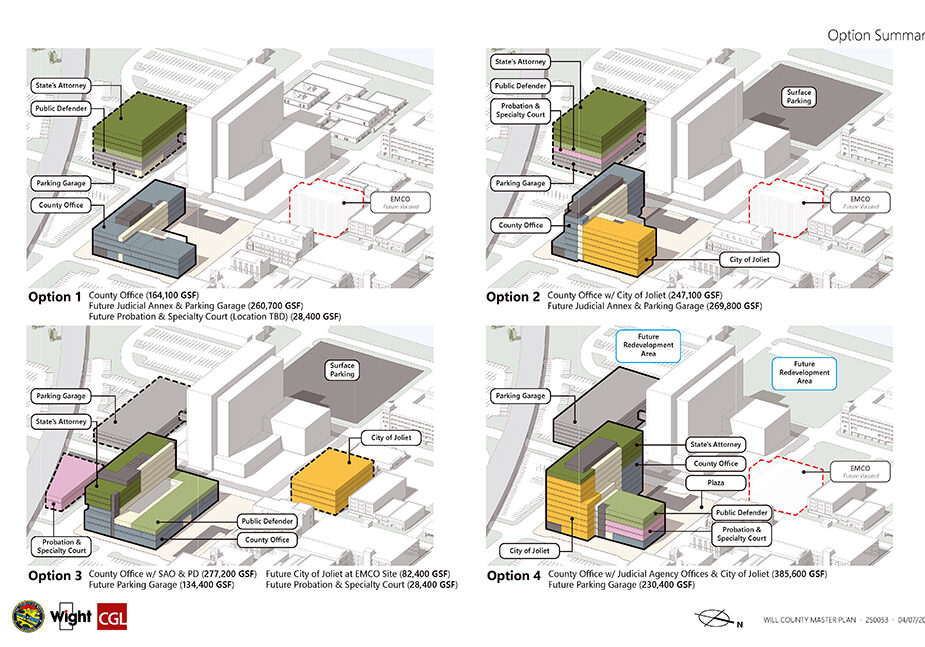
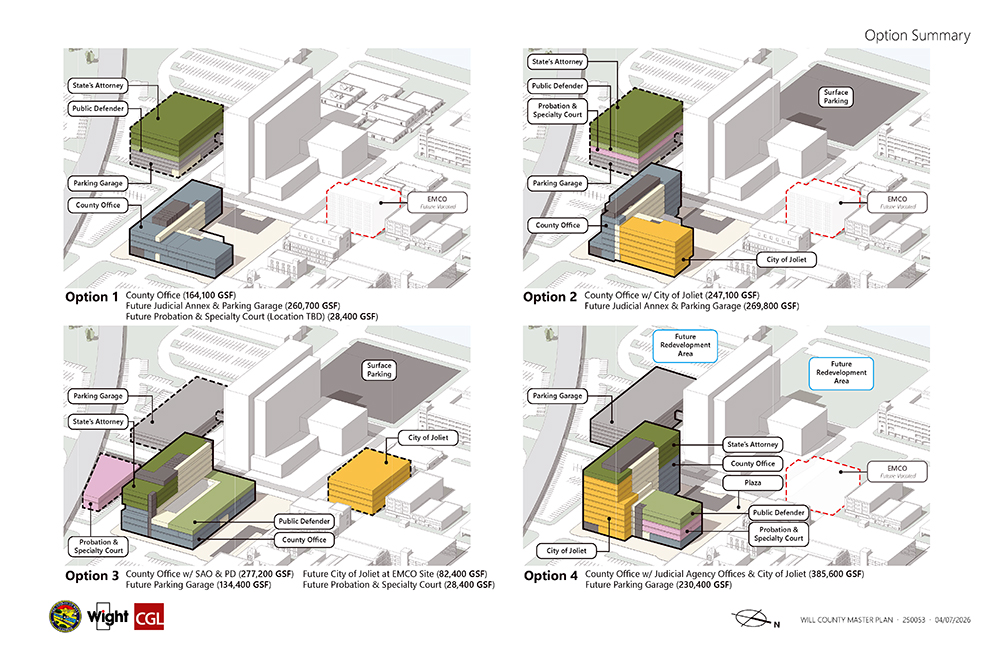
Dwire outlined four distinct options for the committee, all of which heavily utilize the site of the now-demolished old courthouse:
-
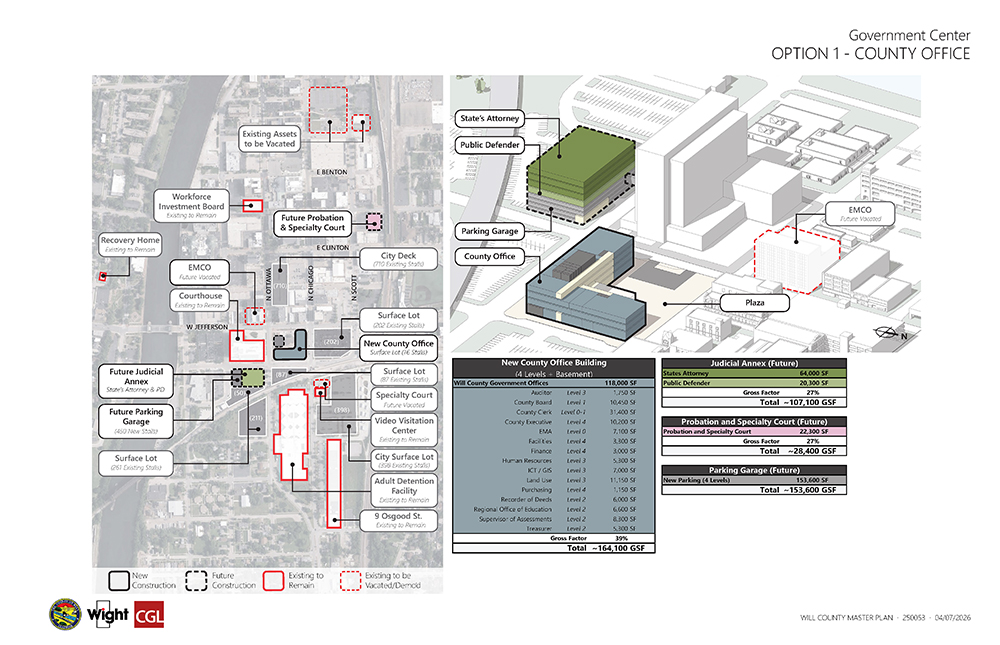
Option 1: Consolidate all county government functions into a new 164,100-square-foot building on the old courthouse site. A separate Judicial Annex and parking garage (260,700 sq. ft.) would be built south of the new courthouse for the State’s Attorney and Public Defender.
-
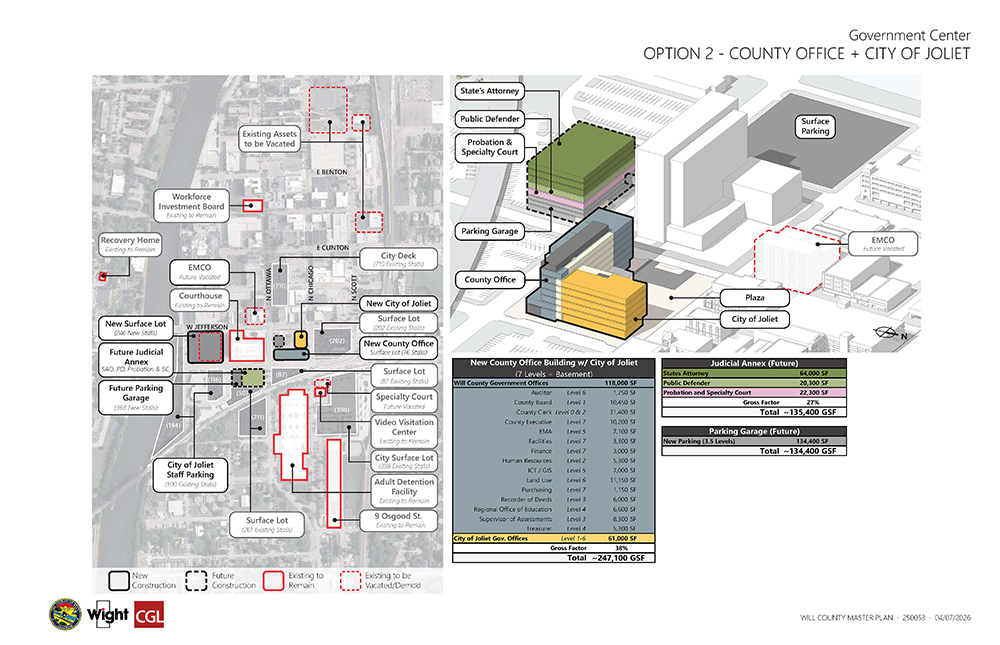
Option 2: Build a joint 247,100-square-foot facility on the old courthouse site housing both Will County Government and the City of Joliet. A 269,800-square-foot Judicial Annex would be built south of the new courthouse.
-
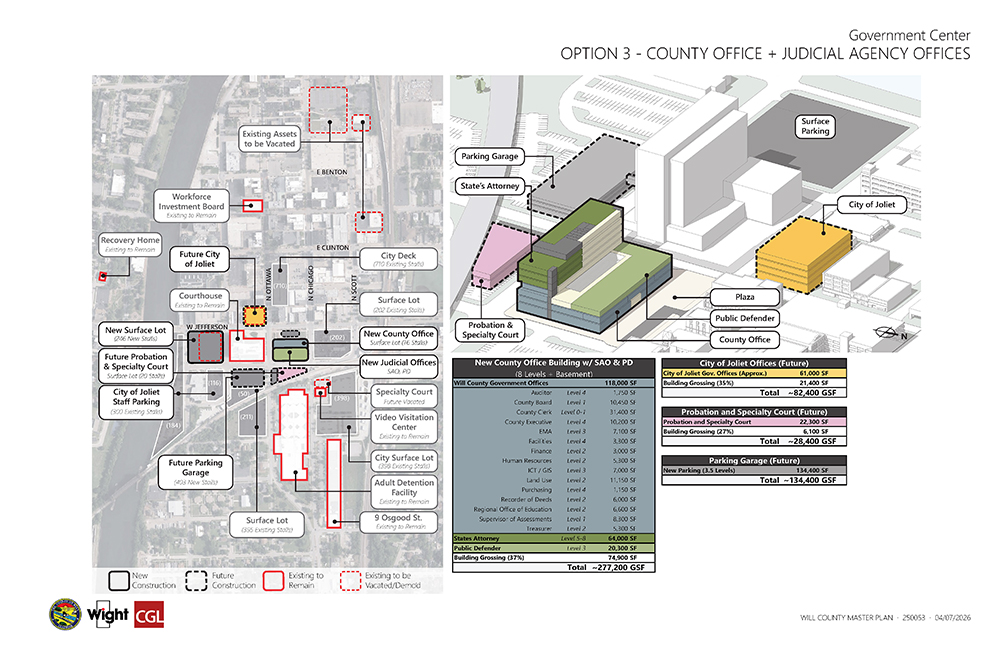
Option 3: Consolidate all county needs—including the State’s Attorney and Public Defender—into one massive 277,200-square-foot building. This would allow the county to abandon the MCO site entirely, potentially offering it to the City of Joliet for a new City Hall (estimated 82,400 sq. ft.).
-
Option 4: A “mega consolidation” placing Will County Government, Judicial Agency Offices, and the City of Joliet into a single 385,600-square-foot complex on the old courthouse site, accompanied by a 230,400-square-foot parking garage.
The prospect of a joint county-city complex drew significant interest from the committee and the City of Joliet. Joliet City Manager Beth Beatty attended the meeting to confirm the city’s willingness to partner.
“The council, the mayor, and I… we have a wonderful working relationship with the county, and we are struggling just as you are with our city hall. I don’t have enough places to put people that we’re hiring now,” Beatty said. “We love the idea of a combined building with the county, so it’s a one-stop shop for constituents.”
Mike Mahony, speaking on behalf of the county executive’s office, noted that a joint facility would offer massive economies of scale, from sharing a single HVAC system and security entrance to utilizing a shared civic boardroom for both County Board and City Council meetings.
To fund such a monumental project, the committee reviewed a debt update prepared by Anthony Miceli of Speer Financial. Following a highly successful bond refinancing in October 2025 that saved the county $5,739,302.60, the county’s debt service payments are positioned to drop off significantly after 2031.
Assuming the issuance of 20-year General Obligation (Alternate Revenue Source) bonds, Speer Financial provided three scenarios that would allow the county to fund construction while keeping its overall annual debt payments level at a targeted $25 million:
-
Scenario 1: A single 20-year issuance in 2027 generating $103,995,000.
-
Scenario 2: A two-part issuance in 2027 and 2030 generating a combined $131,415,000.
-
Scenario 3: A three-part issuance in 2027, 2029, and late 2030 generating $142,810,000.
“You have space and capability to bond out,” Mahony explained. “These are all hypothetical scenarios. We don’t know if we are going to do anything. We don’t know what option we will be looking at… this was just to give you an idea that there is debt service capability for the county that would pay for a project of this magnitude.”
Board Member Steve Balich (R-Homer Glen) suggested an alternative to new construction: expanding the county-owned “PACE building” at 9 Osgood Street.
Mahony countered that the building is currently leased to the City of Joliet for $1 a year on a 99-year lease—an exchange that saved the county nearly $100,000 annually in lease space for problem-solving courts. Furthermore, Mahony noted the building features a 1950s wood roof structure and houses vehicle maintenance on the first floor, making vertical expansion highly problematic due to structural integrity, emissions, and noise.
Despite the logistical hurdles, Balich requested that Wight & Company officially review the PACE building’s expansion feasibility, a request the committee honored.
Board Member David G. Oxley (R-Lockport) requested a comprehensive breakdown of the county’s current lease costs versus the projected savings of consolidation. Mahony noted that the county has aggressively reduced its leased footprint recently—moving the Veterans Assistance Commission and Workforce Services into owned buildings—leaving only Land Use, the Public Defender, and a small ~500-square-foot office for the Workforce Investment Board in leased spaces.
No final decisions were made, as the committee directed staff to return next month with refined cost estimates for the various architectural options.





Mostly Sunny
Latest News Stories

Poll: Majority of Americans believe country not adhering to founding ideals
Trump-backed Letlow wins Louisiana Republican Senate runoff

Poll: Voters more likely to support GOP over Trump

Report: Texas and Florida are leading in tort reform, Boom Belt success

Poll: 96% want Senate candidates to address Social Security cuts
Energy group praises bill curbing EPA regulatory ‘abuses’

Taxpayer cost questions surround push for suicide prevention measures on I-74 Bridge

America 250: Celebrating the first attorneys general who fought for freedom

Texas becomes first state to make Bible required reading

Colorado gubernatorial candidates debate economic issues
U.S. launches retaliatory strikes against Iran

Illinois sued over prediction market law imposing new taxes, regulations