
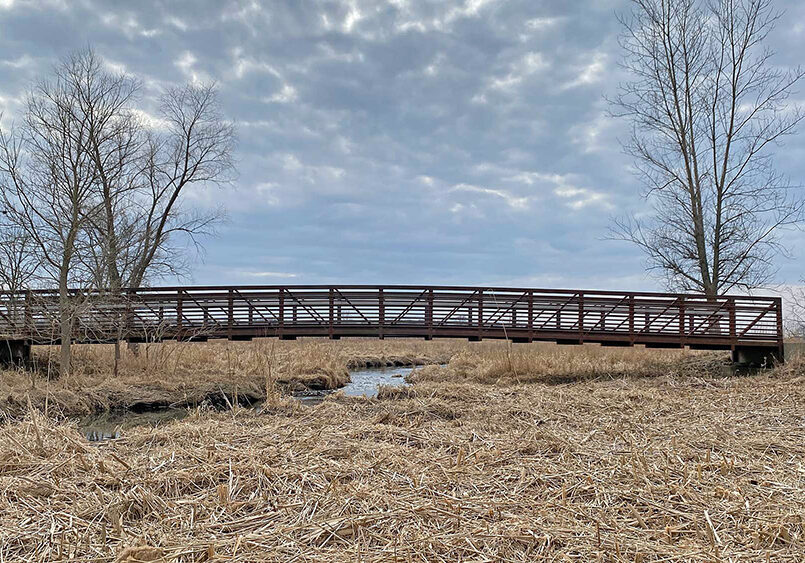
On the road to 100 years: How the Forest Preserve District expanded
That growth didn’t happen by accident. Early on, the District followed a philosophy of one preserve per township, but by the 1980s and 1990s, it shifted to a more strategic land acquisition approach. Plans were developed to identify priority properties and guide future purchases, with a focus on protecting ecological and cultural resources while providing recreational opportunities for the public.
In the past 25 years, the District has invested $350 million to preserve land, extend trails, enhance amenities and create recreational opportunities for residents. By the time the current 2025-2030 Capital Improvement Project has concluded, that total will have increased to $450 million as state and federal grants are added to revenue from the sale of general obligation bonds.
We recently spoke with three previous Forest Preserve executive directors and current Executive Director Tracy Chapman to learn more about how the District expanded during the past 30-plus years as Will County’s population surged.
Mike Pasteris served as executive director from 1989 to 2007. Marcy DeMauro served from 2007 to early 2016. Ralph Schultz served from 2016 to 2025. Chapman became executive director in May 2025.
From about 3,000 acres when Pasteris started to nearly 24,000 today, the Forest Preserve District has come a long way.
Pasteris: Population boom
Pasteris said early land purchases were shaped by flood control efforts and growing awareness of the importance of water resources and ecosystems. As the county grew, so did demand for more protected land and public amenities.
Resident support led to Board approval of a $50 million bond issue in 1989. And two successful referendums in 1999 and 2005 generated an additional $165 million for Forest Preserve expansion.
“That got us on our way,” Pasteris said. “And that’s when we really started … acquiring the sites that we had identified as much as a decade earlier.”
During that period, the District was able to protect key natural areas across the county, including preserves with rare sandy soils in southern Will County and land along Spring Creek in northern Will County to help safeguard underground aquifers.
Pasteris said he is proud of the District’s commitment to conservation, education and building one of the region’s largest trail networks.
“It’s important to put some of those thoughts about ecological preservation into people’s minds when they are young …,” Pasteris said.
The work must continue, he added.
“They’re not making any more land,” he said. “This is all we have. There are still a lot of unique natural resources in Will County, and I’d like to see us expand further in the future. There are some unique areas that we haven’t even touched on yet.”
DeMauro: Watershed Moments
DeMauro, who began working for the District in 1986, said land acquisition evolved as staff began applying more conservation and biology principles. Instead of evaluating parcels individually, the District started looking at habitat, connectivity, access and long-term management.
They also began evaluating land by watershed characteristics.
“A watershed is basically a piece of land where everything drains to the same spot,” she said. “… We identified key areas that were needed to protect the surface water and the surface hydrology.”
Protecting headwaters became a priority, she said, because it helps manage erosion and improve stream quality downstream.
“We have the headwaters of creeks because that’s where it all starts,” she said. “And if we can control erosion there, we can control the quality of the stream and the habitats from that point going south.”
DeMauro said early mapping efforts — long before modern GIS tools — helped identify key resources such as rare bedrock, sandy soils and aquatic diversity.
“This was before computers and before AutoCAD and GIS,” DeMauro said.
Over time, the District’s land acquisition strategy resulted in a more connected system of preserves.
“I think the fabulous story here is how the staff and the Board in supporting all this have been disciplined in seeing it through,” she said. “Because if you look at the County of Will map now and you look where the forest preserves are, it’s a green infrastructure, it’s ribbons of green throughout the county.”
DeMauro also emphasized that the District’s role extends beyond purchasing land to restoring it, and that referendums and grants helped make growth possible.
“We applied for every grant that we could conceivably apply for,” she said. “Since 1999 when we went for the first referendum to by the time I left in 2016, we had secured approximately $32 million in grants to leverage that money. And I consider that wildly successful because you are adding to the value of the public dollars that we were able to receive.”
Schultz: Connecting the Dots
Schultz said one major evolution over time was moving from isolated preserves to a connected system of greenways and trails that allow people to travel through nature.
“One of my main focuses was on connections and getting people out to the forest preserves,” he said.
He said streams, creeks and rivers help create natural corridors that support both conservation and recreation.
“They naturally create connections and continuity in our landscape,” he said. “And they do the same thing for us as human beings.”
Schultz also credited partnerships with municipalities and other agencies for major trail projects, including Old Plank Road Trail, Veterans Memorial Trail, DuPage River Trail and Rock Run Greenway Trail.
“We wouldn’t have an 8.8-mile greenway on the near west side of Joliet had it not been for the willingness of the City of Joliet to partner with us in the ’90s and early 2000s,” he said of the Rock Run Greenway Trail.
He also pointed to the importance of public education, including the creation of visitor centers such as Four Rivers Environmental Education Center in Channahon and the “wildly” successful Hidden Oaks Nature Center in Bolingbrook.
“We didn’t really have a facility located in the northern part of the county, where the vast majority of our population is,” he said of Hidden Oaks, which the District purchased in 2022. “We always felt if we could get our brand of nature education into the community, we would win and our citizenry would win.”
Schultz said cultural resources such as Riverview Farmstead Preserve in Naperville also play a role in the District’s mission by preserving pieces of Will County’s history.
“You see those buildings on the landscape, and it reminds us of a time when we were a different type of community,” he said.
Ralph credited the voters for approving referendums, Board members who OK’d bond issues and the many grants that supplemented those funds. For many, it came down to a choice between more rooftops or nature and they often chose nature, he said.
“We want to make sure that people have access to open space,” he added. “And to be able to get outside. And even if it’s just driving by on the highway, the fact that it’s not built up with runoff and potential pollution that results from that, that’s a benefit to everyone.”
Chapman: The Future Looks Bright
Chapman said land acquisition and restoration will continue to be supported through bond issues and the District’s Capital Improvement Program. The most recent bond issue, totaling $50 million, was approved by the Board of Commissioners in 2024.
“It gives us the funds and the means to make those projects happen,” she said. “In the last 11 months we were able to acquire over 787 acres through the Capital Improvement Program.”
Chapman said three major purchases were finalized in 2025, including a 495-acre acquisition near Goodenow Grove Nature Preserve, a 241-acre parcel in Custer Township and 38 acres adjacent to Riverview Farmstead Preserve.
“Even though it’s a smaller land acquisition, I like that project because it preserves space in an area where we don’t have a lot of green space left,” she said of the Riverview acquisition.
Looking ahead, Chapman said the District has more than 12,000 acres identified as high-quality land for possible acquisition, with both conservation and recreation considered.
“What we’re really looking at is where those two items collide,” she said. “So, we would like the properties to have recreational benefits but we really want them to be high-quality conservation areas.”
Chapman credited previous executive directors with building the system that exists today.
“Those are big shoes to fill,” she said of her role. “And the other executive directors have accomplished big things with big projects.”
She said the District’s work will continue for generations to come.
“The land we protect today shapes how future generations are going to live and recreate in the forest preserves,” she said.
But none of that is possible without preserving land, she added.
“As green space becomes scarce in Will County, it is our job to acquire as much of it as we can today because once it’s gone, it’s gone.”



Mostly Sunny
Latest News Stories
Historic Downtown Frankfort Property Granted Deck and Patio Variances
Frankfort Approves $1.3 Million in Bills, Including Annual Insurance Payment

Meeting Briefs: Frankfort Village Board for June 2, 2025
Library Board Reviews Draft Budget, Praises Staff Investment and Plans for Financial Advisor

Library Board Updates Job Descriptions for Minimum Wage, Adds New Personnel Reporting
Meeting Briefs: Library Board of Trustees for May 27, 2025
Frankfort Park Board Holds Closed-Door Talks on Five Oaks HOA Dispute

Frankfort Township Approves Employee Raises, Details Major Infrastructure and Service Projects

Frankfort Township Approves Employee Raises, Details Major Infrastructure and Service Projects
New High-End Bar ‘Ace & Vine’ Gets Green Light from Township Board
New High-End Bar ‘Ace & Vine’ Gets Green Light from Township Board
Golf Carts Not Permitted on Township Roads, Supervisor Clarifies