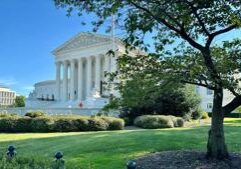
Supreme Court backs immigration officials in green-card holder reentry case
The U.S. Supreme Court threw out a federal appeals court ruling in an immigration case Tuesday and returned the case to the court for an alternative ruling.
In a 6-3 decision along partisan lines, the Supreme Court ruled Tuesday that immigration officers have broad authority to decide if restrictions should be placed on a returning green-card holder even if the government has not yet established by clear and convincing evidence that the person committed a crime involving moral turpitude.
“The Immigration and Nationality Act does not require a border officer to have clear and convincing evidence that a lawful permanent resident has committed a crime involving moral turpitude before deeming the resident an applicant for admission,” the court’s summary reads.
Muk Choi Lau was a Chinese national who became a lawful permanent resident of the U.S. in 2007. But a few years later, he was charged with trademark counterfeiting. While awaiting trial, he temporarily left the country and traveled back to China. He returned a little over a month after he had been charged and “attempted to reenter the country by presenting himself to a border officer” at New York’s John F. Kennedy International Airport, according to the summary.
The officer ultimately determined that the charge against Lau was sufficient to deny him full readmission and instead allow him to temporarily reenter the country under parole while his case was pending. Once Lau was convicted of selling clothing falsely labeled as a well-known brand, the government began preparing to deport him, charging him as “as an applicant for admission who was inadmissible” due to his conviction.
If an immigrant is a lawful permanent resident, that person typically “must be regarded as already admitted to the country and usually [does] not have to reapply for admission when they return from temporary overseas travel,” according to the summary. So Lau fought the government charge, saying that he was a “lawful permanent resident already admitted and subject to removal only on deportability grounds.”
The U.S. Court of Appeals for the 2nd Circuit ruled that immigration officials needed clear and convincing evidence that Lau had committed a crime involving moral turpitude before treating him as an applicant for admission upon his return to the United States. Because Lau had not yet been convicted when he reentered the country, the court concluded that standard had not been met.
The Supreme Court on Tuesday vacated that ruling, holding that the Immigration and Nationality Act does not require border officers to have clear and convincing evidence that a lawful permanent resident committed such a crime before regarding the resident as an applicant for admission. The Court said the government later satisfied its burden during removal proceedings through Lau’s guilty plea.
Writing for the liberal minority, Justice Ketanji Brown Jackson wrote the dissent.
“Congress could not have meant for the guarantees it was affording to be so cavalierly swept aside,” Brown Jackson wrote. “By law, [green card holders] are as close to citizenship as one can get absent naturalization. Today, the majority ignores that crucial fact and empowers government officials to act accordingly.”
The justices remanded the case to the 2nd Circuit to determine whether Lau’s offense qualified as a crime involving moral turpitude.



Chance Rain Showers
Latest News Stories

Illinois quick hits: WARN Act reporting shows 1,600 job losses in October

Pritzker, alders oppose Chicago tax plans, property tax hike could be next
Boeing to pay $36M to family of Indian woman killed in Ethiopia Air crash

WATCH: Lawmakers call out Pritzker for lack of transparency with budget cuts

IL congressman pushes military to accept CLT, experts say it could shape education

New Lenox Solar Farm Gains County Committee Approval with Conditions

Committee Approves Frankfort Township Gaming Bar on Split Vote

Crete Township Senior Group Home Gets Unanimous Committee Support

Beecher-Area Rezoning and Variances Approved to Legalize Structure

Committee Approves Wilton Township Land Division Despite Spot Zoning Concerns

Illinois, Chicago residents rank high taxes as state’s top issue

Illinois quick hits: Illinois House members vote along party lines; More than 40% of CPS teachers missed 10 or more school days; State Treasurer says Bright Start earns gold