
Trump: Data center boom will lower Americans’ energy costs
More data centers will actually mean lower energy costs for most Americans under one of the Trump administration’s initiatives, according to President Donald Trump.
The massive, largely windowless buildings are often seen as a drain on the electric grid, as they require incredible amounts of electricity. But an initiative the administration announced in March called the Ratepayer Protection Pledge has been gaining traction, and the president has said it will not only shield Americans from rising electricity costs but ultimately lower the cost of energy.
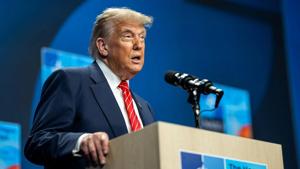
“We are here today to continue the incredible progress we’re making in communities nationwide to ensure that as new data centers go up – and they’re going up all over – electricity bills for American families will actually come down,” Trump said at an event Thursday.
The pledge contains a series of promises that companies that build, own or operate data centers will pay for the new electricity generation and grid infrastructure needed to accommodate new data centers. It also commits them to paying negotiated rates for the “power and related infrastructure that are brought online to service their data centers, whether they use the electricity or not,” and, when possible, making their backup power generation available to help the electric grid during periods of high demand.
The president summed it up Thursday as data centers “paying their own way.”
In March, Amazon, xAI, Oracle, Microsoft, Meta, Google and OpenAI all signed onto the pledge.
However, as of Thursday, nearly 200 additional stakeholders have signed onto the pledge, a White House official confirmed with The Center Square. That includes 23 Republican governors, as USA Today reported, and many others.
“President Trump is expanding the Ratepayer Protection Pledge to governors, legislators, developers, and power providers to ensure everyone involved in building and powering data centers covers their own costs instead of passing them on to American families,” said White House spokeswoman Taylor Rogers in an email to The Center Square. “The President’s bold action is turning data centers into engines of growth for local communities, while cementing America’s dominance in the global AI race.”
The pledge will now cover 80% of all the power delivered in America to homes and businesses, according to the administration.
Much of the pledge appears to formalize practices that many hyperscale data center operators have already been pursuing.
When the pledge was first released, economist Ike Brannon described it as “vague” and “aspirational” in talks with The Center Square. Brannon coauthored a report in 2024 on preventing rising costs for ratepayers amid the data center boom.
“It seems clear that there’s no real way for the government to actually make any of these happen,” Brannon said, referring to the first several points of the pledge. “Worthy aspirations, but that’s it.”
However, some lawmakers have also introduced related legislation.
Reps. Gabe Evans, R-Colo., and Kathy Castor, D-Fla., introduced a bill in June that unanimously passed out of committee that would “establish a Federal standard relating to the recovery of the full, incremental costs of [grid] upgrades that serve large-load customers, and for other purposes.”
On Monday, Rep. Byron Donalds, R-Fla., also introduced the Protecting Ratepayers Act, which would codify the president’s pledge and require data centers to “independently source water and power, bypassing public infrastructure.”






Slight Chance Rain Showers then Mostly Cloudy
Latest News Stories

Chicago’s potential ‘teen takeover’ solutions cost taxpayers

Congressional proposal aims at ‘loophole’ for ideology policies

Illinois Quick Hits: Opioid overdose deaths decline in Cook County

WATCH: How data centers rescued a struggling central Washington community
Oppenheimer’s grandson supports nuclear energy bill
Trump expresses frustration with NATO as Rutte praises the president

Ex-fire chief sues Los Angeles mayor for defamation
Over $10 billion U.S. taxpayer dollars spent on improper SNAP payments in 2025

Teachers unions call for special session, more money

Illinois Quick Hits: Bond, TIF money helps fund Chicago neighborhood grants

Trump won’t sign bipartisan housing bill, reignites voter ID debate
Poll: Two thirds say gas prices will shape their November vote