Debate persists over nation’s highest gas prices in California
A “mystery surcharge” at the pump costs Californians millions of dollars a year, according to a new report from the state Division of Petroleum Market Oversight.
It’s part of the debate over reasons for the nation’s highest gas prices, which for years have been in California. The report points to oil companies as the cause of the surcharge, but critics of the report blame overregulation, taxes and refinery closures for price hikes.
Between 2015 and 2024, drivers in the Golden State paid what the report called a mystery surcharge at the pump that averages 41 cents per gallon, costing Californians $59 billion. This is an extra cost that isn’t accounted for by taxes, fees or the cost added at the pump for state-run environmental programs, the report says.
Higher gross gasoline industry margins was the one factor that contributed the most to the rising price in the gas mystery surcharge, according to the state agency’s report. The division said the surcharge hit a record high of $2.44 when it first appeared in fall 2022. It later fell to $2.02 in fall 2023.
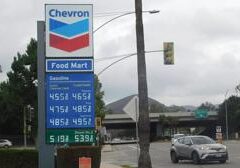
But others point to refinery closures and regulations as the reasons for prices that are now above $4.60 a gallon.
According to a California Energy Commission list published in 2024, there were 13 refineries in the state. But there have been several closures, including Phillips’ 66 Wilmington facility in Los Angeles. A Valero refinery in Benicia is moving ahead with closing its doors.
“You have some lost refining capacity in the state,” Denton Cinquegrana, chief oil analyst for Oil Price Information Service, told The Center Square.
The state’s remaining refineries are in areas such as Los Angeles, Richmond (near San Francisco) and Kern County.
The Division of Petroleum Market Oversight’s report shows that half of the state’s refined oil sales are through four of the oil refiners’ direct sales arms, which also drives up the price of buying refined oil. The report said the cost is passed on to consumers at the pump for branded gasoline markups.
However, some give other reasons for why California’s gas prices are so high.
“The biggest driver is overregulation,” said Assemblymember Stan Ellis, R-Bakersfield.
“It’s become so burdensome,” he said, comparing it to “driving down the road and having a highway patrolman police you 24/7.”
Ellis, who worked in the oil industry, said he believes regulation and the cost of getting permits to put in equipment, expand operations and repair existing equipment makes doing business that much more challenging in California for refineries.
“The solution is that the Trump administration could come in and federalize oil and gas, get away from the CEQA [California Environmental Quality Act] regulations and CARB [California Air Resources Board], and let’s get on with producing and getting these permits,” Ellis told The Center Square. “We need thousands of permits. We need to drill. We need to get offshore back on track.”
The Pacific Research Institute, a Pasadena-based organization that advocates for free-market solutions, published a report this month showing that the state’s oil refineries often operate at a loss.
The research also concludes that rather than a mystery surcharge driving up gas prices, it’s the cost of doing business and the high cost of regulations in California.
“There is no ‘mystery surcharge.’ It’s a policy-driven price premium that we have in California,” said Wayne Winegarden, a senior fellow in business and economics at the Pacific Research Institute, who conducted the research with his colleague Kerry Jackson.
Winegarden said he believes some of the Division of Petroleum Market Oversight report’s key findings take too simplistic a view of the numbers.
The report’s authors were too focused on the refineries’ gross margin (the revenue to cover expenses), not the net margin (profit), Winegarden told The Center Square.
He pointed to other factors driving up prices, such as state and federal excise taxes, state and local taxes, and underground storage costs for gasoline.
“When you take into account the broader regulatory burden, there’s no ‘there’ there,” Winegarden said. “It’s so expensive here because of the regulations. Our regulations have made it unprofitable to produce while still charging consumers an excessive amount, and that’s a really scary realization.”
Cinquegrana said the high demand for gas in California drives up the cost of gas. But the oil analyst added that the cost of doing business in California drives up cost even more.
“California is still a gigantic consumer of gasoline,” Cinquegrana told The Center Square. “I think part of it is also the political environment in the state has made it difficult for refiners to operate. Obviously, running a refinery in California is quite expensive, and anyone who has a refinery is always going to talk about how their cost per barrel is more in California than any other state in the country.”
The Division of Petroleum Market Oversight report also notes the additional cost of branded gasoline. The surcharge at brand-name stations has increased to 75 cents a gallon since 2015, the state agency says.
The February 2015 Torrance Refinery Fire, meanwhile, is one of the root causes of the dramatic rise in California’s gasoline surcharge, according to the report.
This fire reduced California’s oil refining capacity for more than a year and made gas prices spike, the report says. After the refinery was repaired, the high prices persisted, with the average surcharge rate of $1.23 per gallon after 2015, up from 54 cents.
The new Division of Petroleum Market Oversight report comes just months after Gov. Gavin Newsom signed several bills that aimed to stabilize the state’s petroleum supply to keep gas prices down, The Center Square previously reported.
“We’re stabilizing the state’s gasoline supply to avert severe price spikes at the pump, and we’re making it easier to build the abundant clean energy we need to keep bills lower,” Newsom said during a September press conference in which he signed those bills.
California continued to have the nation’s highest gas prices Friday with an average price at $4.63 a gallon, according to AAA, which tracks gas prices across the country.
The state’s highest average gas prices are in Los Angeles, Ventura, San Diego, San Luis Obispo, Del Norte, Siskiyou, Humboldt, Trinity, Sierra, Nevada and Inyo counties. The single county with the highest average gas price is Mono County, where stations sold gas for $5.94 a gallon on average on Friday. Yuba County saw the state’s cheapest gas, at $4.20 a gallon.
After California, nine other states lead the nation with higher prices. They are, in order from the highest to the lowest on Friday: Hawaii (with the nation’s second highest price), Washington, Oregon, Alaska, Nevada, Arizona, Pennsylvania, Idaho and Illinois. Each of those states sells gas that costs between $3.29 and $4.63 a gallon.
Recent data from the U.S. Energy Information Administration shows gas prices on the West Coast have gone up an average of more than 24 cents, which is a higher price hike than any other region in the country over the last year.
A recent AAA press release noted the national average has remained slightly above $3 a gallon.
“Gas prices have remained relatively quiet this month thanks to an abundance of crude oil,” the AAA said in the release. “As we prepare to enter the busy Thanksgiving travel period, pump prices are expected to remain where they are now or drop even lower.”
The cheapest gas in the country on Friday was sold in Oklahoma, at an average price of $2.56 a gallon, according to AAA.
The Bureau of Labor Statistics reported recently that gasoline prices went up in September more than any other consumer good, rising 4.1%. Comparatively, food and energy prices both rose 0.2% the same month.
“Regulators talk about the California ‘mystery surcharge,’ but it’s no mystery at all that the state has been working for years to put refiners out of business, and now the result is shortages and high prices,” said state Sen. Megan Dahle, R-Bieber, who sits on the Senate Transportation Committee.
“As usual, the predictable burden on the consumer is the last thing on the mind of decision-makers in Sacramento,” Dahle said in an email to The Center Square.
Community Events
Latest News Stories

WATCH: Trump says ‘dangerous’ Chicago next after addressing crime in D.C.

Illinois quick hits: Pritzker signs abortion bills; Operation Purple Heart returns medals
WATCH: IL Department of Human Services’ adverse audit draws legislators’ ire

Illinois prisons to publish annual data on contraband, safety and overdoses

Commission enacted to aid young IL farmers facing challenges
Will County Executive Proposes $791 Million Budget Focused on Stability Amidst Economic Uncertainty
WATCH: Detransitioner gets a second chance at medical malpractice lawsuit
WATCH: CA Democrats pass congressional redistricting plan
Pew: U.S. immigrant population declines for first time in nearly 60 years

WATCH: Illinois’ FY23 financial audit released amid criticism of tardy reports
European Union says U.S. consumers will end up paying tariffs

Illinois quick hits: Anti-SLAPP bill signed; Chicago schools settles meditation case